Jupiter
Mars Saturn
Earth's Moon
Earth Sol Uranus
Venus Neptune
Mercury Pluto
 
click us


Prepare to Explore the Solar System!

The Grouse Ridge Lookout Solar Model is a scale model of our Solar System, situated in Grouse Ridge Campground, Emigrant Gap, Cisco Grove, Big Bend, and Baxter, California, USA.

The model is now complete.  Below you will find links to related sites. If you are an avid Geocacher, you will want to skip these details and go directly to http://www.geocaching.com, and search away. Hint: the zip code for Emigrant Gap is 95715.

General overview

The scale of this model is 1 inch equals 5000 miles.
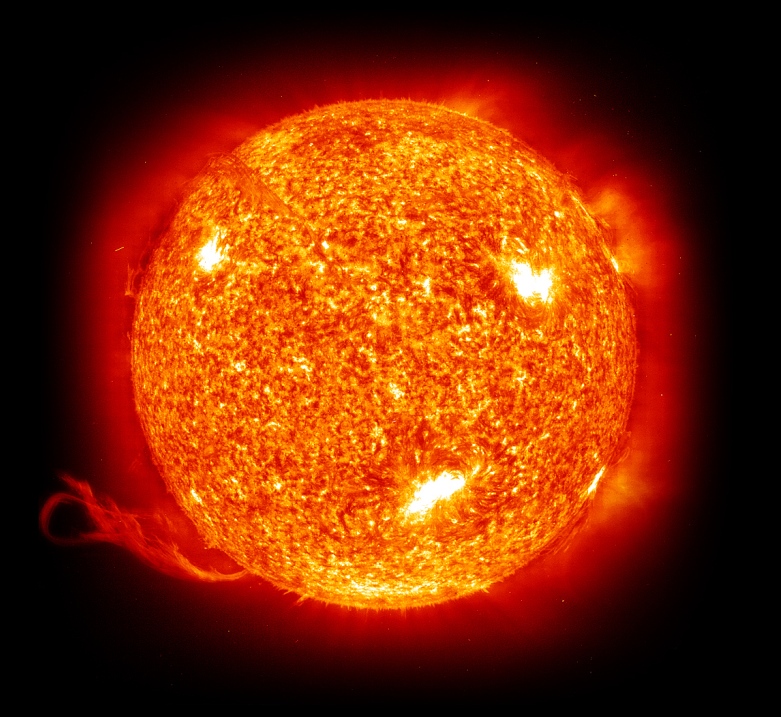
Sol, (our sun,) is represented by the Grouse Ridge Lookout.  At 14.4 feet across it's exactly the right size for the scale, and it can be seen from a long way off - this is very important for this project.
Mercury is only 600 feet away.  In fact, all of the inner planets are within about a mile and a half.
After Jupiter, the distances start to take rather large leaps.  The furthest, Pluto, is almost 12 miles away!
All planetary positions have a clear view of Sol! (at least during nice weather.)
All planets have their coordinates posted both here and at the Geocaching site.  (You will need a GPS to cruise the model.)
You may download all planet waypoints to EasyGPS for Groundspeak here

The Planets

Object

Comments
Sol

N39 23.178
W120 36.759

The Sun: The Grouse Ridge Lookout building itself.
Mercury N39 23.267
W120 36.741

These are the inner planets, and are all on or near the peak of Grouse Ridge. Earth is in a relatively safe spot, but the rest of the inner planets are rather near some pretty nasty cliffs (not recommended for small children.) All of these caches have fantastic views, bring your camera!

Venus N39 23.356
W120 36.791
Earth / Moon N39 23.155
W120 36.434
Mars N39 22.927
W120 37.143
Jupiter N39 22.223
W120 37.961
First of the outer planets.
Saturn N39 23.690
W120 33.698
The longest hike of the bunch, but not the most difficult.
Uranus N39 18.945
W120 33.535
Short but semi-difficult hike; very rocky; cliffs.
Neptune N39 17.573
W120 30.438
This one's a good day-hike. Steep, 2.5 miles, and Very Rocky - but it's well worth it!
Pluto N39 15.135
W120 44.923
This is by far the most dramatic in scale. Don't miss it.

Other Info

Some of the planet caches contain a "reference stick", of the scale size appropriate for the planet it represents. At one time, they all had these - but some have disappeared, probably to be lost among the flotsam of the asteroid belt. Therefore, I suggest bringing an 18" ruler along with you, or a measuring tape, such that you can select a local rock to represent your planet (or simply hold up the ruler in the case of the larger planets!)

All of the inner planets can easily be visited in one day trip. One can see all but Neptune and Saturn in a day without much effort. With a little work, you could probably add Saturn or Neptune into a day trip. At this point, no one has completed all 10 caches in a single day, although it is probably possible. If you want to spend some time between planets, campsites are available at Grouse Ridge itself.

Depending upon your group, you have a few options to maximize your enjoyment of a single day trip. I recommend one of the following scenarios, starting from easy and getting progressively harder:

The Celestial Alignment Tour

  • Start with Sol, to get a clear idea of the size of our sun
  • Visit Mercury and Venus on the way to Earth
  • Have a picnic on the peak near Earth, it's a great place to spend time
  • Get in the car and drive to Mars, Jupiter, and Pluto
  • End of tour

The Solar Whirlwind Tour

  • Start with Sol, to get a clear idea of the size of our sun
  • Visit Mercury and Venus on the way to Earth
  • Stay at Earth only long enough to perform an eclipse for everyone in your group
  • Get in the car and drive to Mars, Jupiter, Uranus and Pluto
  • End of tour

The Expanding Universe Tour

  • Start with Sol, to get a clear idea of the size of our sun
  • Skip Mercury and Venus, go directly to Earth
  • Stay at Earth only long enough to perform an eclipse for everyone in your group
  • Get in the car and eat lunch while you drive to the Locke Leven trailhead
  • Hike to Neptune
  • Return to car, end of tour

The Return of Expanding Universe Tour

  • Start with Sol, to get a clear idea of the size of our sun
  • Visit Mercury and Venus on the way to Earth
  • Stay at Earth only long enough to perform an eclipse for everyone in your group
  • Have a Cliff bar (you're going to need it)
  • Hike to Saturn, and picnic there
  • Return from Saturn, Get in the car and drive to Mars, Jupiter and Pluto

The Hardcore Space Veteran Tour *

  • Fill your hydration pack with Citomax
  • Start with Sol, to get a clear idea of the size of our sun
  • Visit Mercury and Venus on the way to Earth
  • Stay at Earth only long enough to perform an eclipse for everyone in your group
  • Jog the trail to Saturn, and eat a high calorie protein bar or two
  • Return to the Grouse ridge lookout parking area, get in the car and drive to Mars and Jupiter
  • Eat lunch while you drive to the Locke Leven trailhead
  • Check your watch - if its later than about 1:00 or 2:00 in the afternoon, consider canceling Neptune
  • Hike to Neptune and back
  • Return to car, drive to Uranus, then Pluto
  • End of tour

* Hardcore Space Veterans: I don't know for sure that this is possible, and I'm only guessing at the timing. However, if the entire series could be done in a day, this would be the best order to do it (I'm pretty certain on that.) If you are not in shape to hike hard and fast over rocky, steep trails at elevations of 7,000' plus, please do not attempt the Hardcore Space Veteran Tour.

For Groups

If you think you would like to take your school group, or for any other reason you would like advice planning your planetary excursion, please contact me and I'll try to help.

I am currently attempting to get together a set of authentic looking scale planets for school groups to borrow. I'll post more about this when they are ready.


You'll just have to wait!

You can read the descriptions and find out the scale dimensions and orbital distances, and you'll certainly have all the data. However, you really need to pick up a planet in your hand, holding it up toward the GRL, and see how far it is to Sol. Until you do that, it's just numbers on paper. When you actually see it, well, just try it and find out!

If you visit only one planet, make it Earth! Earth has its moon tethered to it, and the dimensions are a bit of a surprise to most people. For a really good time, try this: Have someone hold up the moon at the end of its string, and you hold Earth next to your head. If you move around a bit, you will find that you can "eclipse" the Lookout, just as the real moon does the real sun. It's a blast! Try it! :-)


© 2003 - 2008 Andy Brannan - updated April 23, 2009